s3-vedrfolnir
A web data browser for S3. It reads the key space as the tree that data workloads deposit there in practice — and lets you query the objects underneath with SQL, not just download them.

Tech
- S3
- Object Storage
- SQL
- DuckDB
- Iceberg
- Open Source
Most S3 browsers already interpret / as a folder separator: you browse the tree, download an object, and that’s the end of the interaction. s3-vedrfolnir targets a more specific audience: the people who put data in S3. For them, the key space isn’t just a file hierarchy — it’s a structured schema, meant to be browsed and, above all, queried.
In practice, S3 keys represent a hierarchy
Technically, S3 is still a key-value store: no real folders, just keys — and not necessarily files either, but objects, which can represent or store any kind of data (even a fragment of a binary stream, with no defined beginning or end). And real-world usage isn’t universally tree-like — content-addressable stores (Git LFS, some registries), hash-based sharding, or shallow media/CDN buckets legitimately do without one.
But that’s not s3-vedrfolnir’s audience. The tool targets data/analytics workloads, and there a tree layout is the norm — by convention, not by accident. Hive-style partitioning (year=2024/month=01/day=15/) is the de-facto standard for modern table formats (Iceberg, Delta Lake, Hudi) and every engine that reads them. The people who model these structures are human, and humans have been used to files and folders since well before the computer: imagining a hierarchy in S3 keys is only natural. s3-vedrfolnir starts from that premise to extract a tree and present the files in it.

Hive-partitioned keys (year=2026/month=08/day=11/) read as a folder hierarchy, with breadcrumbs and per-folder operations — not a flat namespace.
The objects are data — so query them
For data use cases (Iceberg, Parquet, CSV, JSON…), an object isn’t an opaque blob. It’s a dataset. The AWS console or the MinIO console will show you the key and let you download it, and there it stops. s3-vedrfolnir goes one step further: it knows the key tree is a tree of data files, so it lets you inspect and query them with SQL. Read the data, not just the metadata.
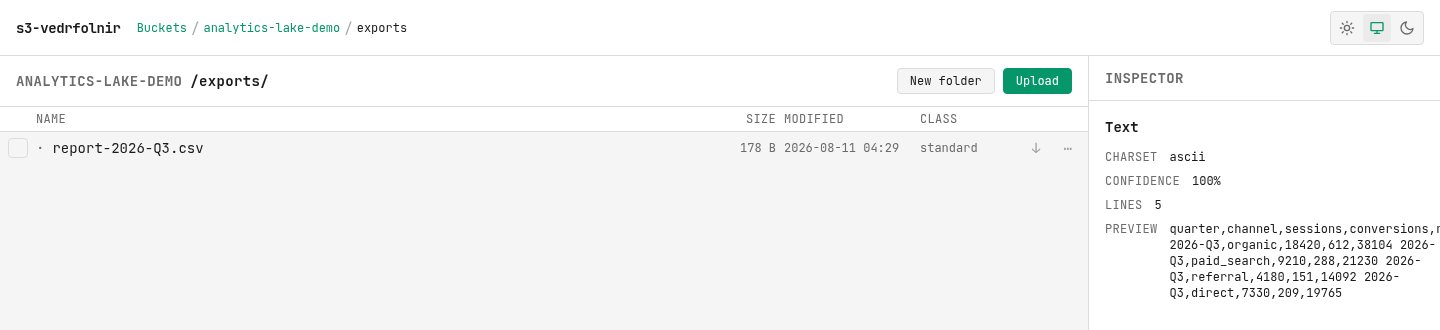
Selecting an object reveals its contents: detected encoding, line count, a preview — you read the data, not just the key.
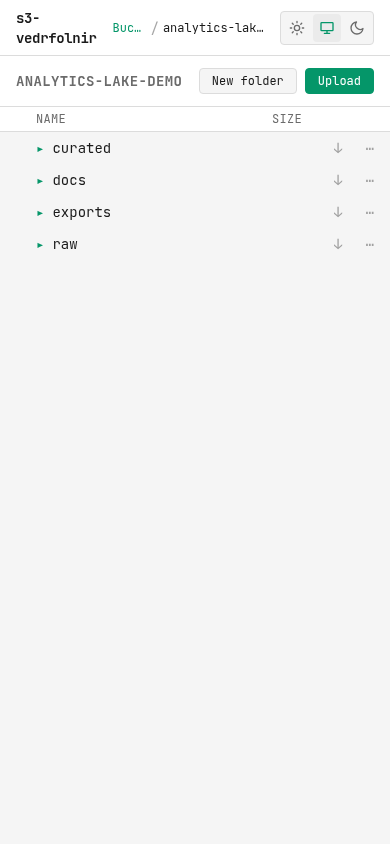
The interface is built for the field, including on mobile, where the tree collapses into a compact list:
Veðrfölnir, in Norse myth, is the hawk perched atop Yggdrasil — the world tree — watching over all of creation. A tree of S3 objects, read from top to bottom. The metaphor was too good to pass up.
Status: v1.0-RC, in production on my own infrastructure. Public demo and open-source release to come.
Comments